

Issue No. 7 | April 2026
My Dearest Table Guests,
Prim is writing this on a Thursday morning that is not like other Thursday mornings, because today is the one Thursday a year that the entire country has agreed to sit down at the same table. National Mahjong Day has arrived. Prim told you a week ago it was coming. She does not regret the fanfare. Somewhere, as you are reading this sentence, a woman in Ohio is setting out her tiles next to a vase of tulips. Somewhere else, a teacher in South Florida is letting a brand new player build her first wall. Somewhere in between, a Thursday game that has been running for eighteen years is welcoming a fourth who has not sat at a mahjong table since her grandmother's. This is the day. The whole country is reading each other's Thursday, and Prim finds that unspeakably beautiful.
Before Prim goes any further, she has to tell you about someone who never played a single hand of mahjong, because this morning Prim cannot stop thinking about her. Her G. Which is what Prim has always called her grandmother, and always will. G did not know a bam from a crak, and she would have giggled affectionately at the whole enterprise of racks and pushers and Charlestons. What G knew was how to be a good human, and how to laugh until the whole room had to sit down with her, and Prim has never laughed harder with anyone, before or since. Today is a day about women gathering at tables across the country, and Prim finds herself thinking about the women who built the tables without ever touching a tile. The ones who taught us how to show up, how to listen, how to pour the second cup of coffee and mean it. G was one of those. She will wander into these pages from time to time, because the game is about attention, and G was the most attentive person Prim ever knew. Today's wall is built in her honor.
Which brings us to the theme that has been tapping on Prim's shoulder all week. Every discard tells a story. Every exposed meld is a sentence. Every sigh, every pause, every deliberate pick from the wall is a small piece of information that the table is quietly filing away. The players who win consistently are not the ones with the fastest hands or the luckiest pulls. They are the ones who are reading the story everyone else is accidentally writing. Prim wants to spend this issue helping you become one of those players, because the game rewards attention more than it rewards anything else, and today of all days seems like the right time to tell you so.
We will talk about the discards you are throwing without thinking. We will talk about the things you are saying at the table that you should probably stop saying. We will meet a teacher who has been reading racks since the Nixon administration. And we will travel back to the 1920s, to the precise moment American Mahjong broke from Chinese Mahjong and invented an entirely new relationship with the discard pile. Pull up your chair. The wall is built. The holiday is here. Let us begin.
Prim
I come bearing gifts for my favorite fourth this week. Keep reading!Prim
The Draw
The holiday has arrived, and the whole country is reading each other’s Thursday
The photos started rolling in before sunrise on the East Coast, which is exactly what you would expect from a community that has been rehearsing for this morning since Issue 6 dropped. Prim has seen three coffee-and-tiles flat lays before she finished her own coffee. She has seen a grandmother in a cardigan setting up at the kitchen table in Westchester, a sorority reunion in Atlanta turning a hotel suite into a four-table tournament, a library in Minneapolis putting out six folding tables and a sign that reads "All Players Welcome," and a woman in Seattle who posted a photo of her rack with the caption "first game in twelve years, she would be proud," and Prim does not know who she is, but Prim is tearing up a little on her behalf. This is the day. This is what we built.
Now let Prim be specific about what is actually happening out there, because the community pulse this week has been doing one thing and one thing only, which is rallying. The Facebook groups have been organizing open tables. Local instructors have been running free lessons. JCCs from coast to coast have opened their doors for drop-in play. The Mahjong companies in your local neighborhood released limited National Mahjong Day drops that sold through before breakfast. Instagram has been a flood of tagged posts that are not selling anything, which is the rarest thing on the internet, and it is because today is not about commerce. Today is about being counted. Every woman posting her rack with the hashtag is saying, I am here. I play this game. I belong at this table. And the community, as it scrolls, is writing itself into a mirror.
Prim would like to note one thing about the mood of it. There is a gentleness in this community today that you do not see at every tournament weekend. The players who competed in Las Vegas and West Virginia last weekend are home, tired, proud, and a little reflective. The newer players who watched tournament season from a distance are stepping forward, cautious but curious. The veterans are teaching. The beginners are learning. And for one day, the Facebook groups are quiet, because everyone is too busy playing to argue about anything. Prim will savor this. The debates will be back by Monday. They always are. But today the table is wide, the welcome is warm, and every discard you throw today is being thrown in the company of a hundred thousand other women doing exactly the same thing, at exactly the same moment, in exactly the same spirit. If you have not yet picked a tile this morning, close this letter, go pour your second coffee, and build your solo-mahjong wall. Prim will wait.

Crak The Card
Defensive discarding on the 2026 card, or what your discards are telling the table
Prim has been watching discards for thirty-some years, and she can tell you plainly that most players spend ninety-five percent of their mental energy on the hand they are building and five percent on what they are throwing into the center of the table. This is backwards. Your discards are the single biggest public document you produce during a game. The table reads them whether you mean for it to or not, and on the 2026 card, with its dense Consecutive Runs section and its punishing Singles and Pairs, your discards are either helping the table beat you or helping you protect your own ambitions. Let Prim walk you through three defensive discard principles that actually matter this year, because the conventional wisdom is mostly generic and the 2026 card rewards specificity.
Read the exposure before you throw the tile.
Here is the mistake Prim sees at every table, every week, and it is not a beginner mistake. It is a mistake veterans make because their attention drifted for a single pick. A player across the table exposes a pung of three bams. You glance at it, register it, and then on your next turn you throw a four bam, because four bams is what you happen to be holding and the hand you are building has moved on from bams entirely. Stop. You have just given that player a potential Consecutive Runs meld, and on the 2026 card the Consecutive Runs section is one of the richest scoring categories on the card. Before you throw any number tile, look at every exposed meld on the table and ask yourself a single question. Does this tile extend, pair, or complete any of those exposures? If the answer is yes, you need a compelling reason to throw it anyway. On the 2026 card, "I do not need this tile" is not a compelling reason. Your opponent might need it very much.
The extension to this principle is about suit discipline. When an opponent exposes in a single suit, the next three to five discards from the rest of the table should treat that suit as radioactive unless there is no alternative. The 2026 card has a remarkable number of hands that lock into a single suit for most of the hand and then require two or three specific tiles in a second suit for the singles and pairs components. An exposed crack pung does not tell you she is playing cracks. It tells you she might be, and the cost of being wrong about that is a called tile and a lost hand. Play the probabilities. Read the exposure. Then throw.
The defensive pivot on Singles and Pairs.
This one is specifically a 2026 card warning, and Prim wants you to hear it clearly. The Singles and Pairs section this year is unusually dense, and because jokers cannot be used in pairs or singles, every player working toward a Singles and Pairs hand is pulling natural tiles from the wall or calling them from discards, and they are calling them with precision. What this means defensively is that mid-to-late in the game, as the wall gets thinner, the discards that become dangerous are the ones that pair up previously discarded tiles. If you threw a five dot in round three and the game has moved on, and now in round seven you are about to throw another five dot, pause. Every pair you complete in the discard pile is a pair someone at the table can potentially call, because the 2026 Singles and Pairs section is full of hands that are one tile away from closing, quietly, without any warning at all.
The countermove is what Prim calls the discard memory discipline. You do not have to memorize every tile thrown. You only have to glance at the discard pile before you throw a tile you have thrown before, and ask whether you are handing someone a completion. Late game, this discipline is the difference between winning and watching someone else win. The Singles and Pairs player is not loud. She is not exposing. She is not giving you the signals you are used to reading. The only signal she gives is the moment she calls your discard, and by then the hand is over.
The courtesy discard is a weapon. Use it like one.
The third principle is about intention, and it will not appear on any strategy blog because it is not a technical rule. It is a table rule, the kind that only gets taught in person, in quiet moments, by teachers who have seen ten thousand games. When you reach the point in the game where your hand is not going to close, and the table is still in motion, you have a choice. You can discard whatever is least useful to you. Or you can discard the tile that is least useful to whoever is closest to winning. Those are often not the same tile. A player who has exposed three melds in a single suit is not going to win with a tile from a different suit. If you are between throwing a tile that matches her exposures and a tile that does not, the polite and strategic move is the same move. Throw the tile that does not help her. This is not sabotage. This is not table etiquette violation. This is attention, paid carefully, at the moment attention matters most.
The 2026 card rewards this kind of thinking, because the card's difficulty is concentrated at the margins. Games are being decided by a single tile. The player who is paying attention to what her table actually needs, as opposed to what her own hand is doing, is the player who ends the session with the most bingos and the fewest regrets. Your discards are the clearest picture the table has of how carefully you are paying attention. Every one of them tells a story. Prim would like yours to be the story of a player who is reading the table as carefully as she is reading her own rack. That, more than any hand-building technique, is the real Crak the Card lesson of the season.
The Table Is Asking
Table talk, and what your words are giving away
The question arrived this week from four different tables, in four different cities, phrased four different ways, but they all pointed at the same thing.
"What is actually appropriate to say during a mahjong game? I keep getting it wrong and nobody will tell me the rule."
Prim has been waiting for this one, because there is not a clean rule anywhere, and the community has been arguing about it for as long as the community has existed. Let her give you her take, which is pointed, and which will probably not please everyone, but which Prim believes will make you a better tablemate than whatever advice you have been getting from the sweet older woman in your game who is too polite to correct you directly.
The first thing to understand is that table talk is not one thing. It is three things, and they are governed by three different standards. There is the social layer, which is the conversation about anything other than the game in progress. There is the strategic layer, which is anything you say that could communicate information about your hand or your intentions. And there is the operational layer, which is the necessary ritual speech of the game itself, the calls, the announcements, the rulings. The rules about each layer are completely different, and most players who are getting table talk wrong are confusing the layers without realizing it.
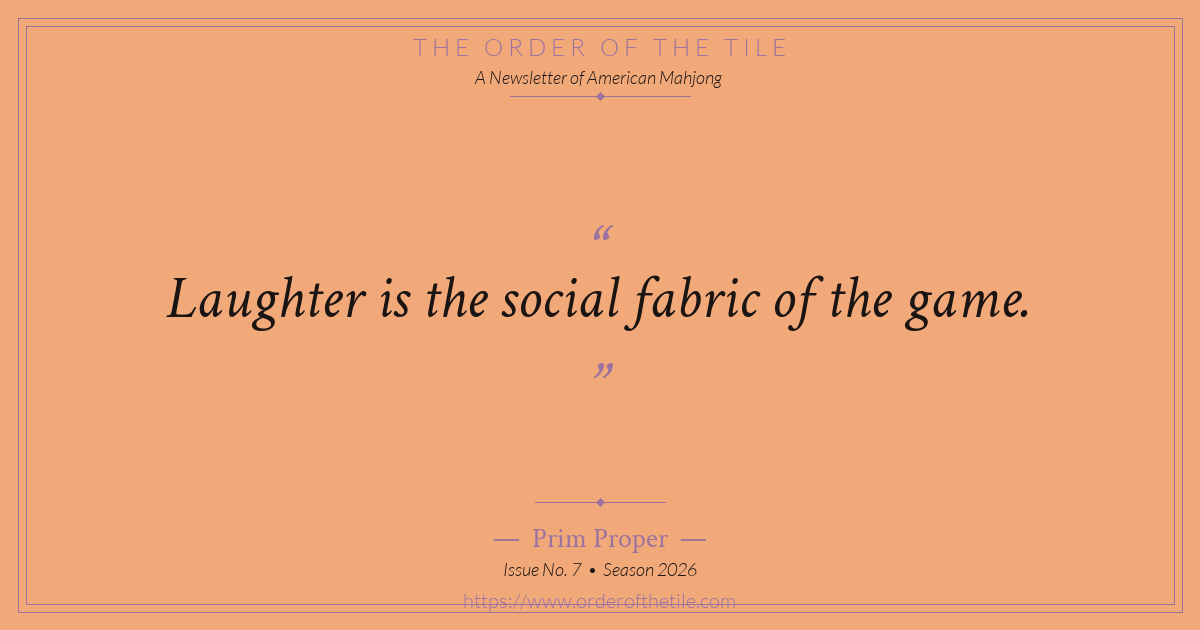
The social layer is nearly unrestricted, and Prim thinks that is correct. You should be talking to your tablemates. You should be laughing, catching up, asking about the grandchildren, complimenting the mat, arguing good-naturedly about which teacher's class everyone should take next. This is the social fabric of the game, and a silent mahjong table is a sad mahjong table. A tournament table is different, of course, and at tournaments the social layer contracts to near silence. But at your Thursday game, in your friend's dining room, the social layer is not just permitted, it is expected, and a player who sits through an entire hand in stony silence is doing the room a quiet disservice.
The strategic layer is where Prim has opinions, and she is going to give them to you without softening. Anything you say that reveals information about your hand, your target, your jokers, your Charleston strategy, or your read on another player is a violation of the spirit of the game. This includes thinking out loud about what you are about to do. It includes groaning when you pick a tile. It includes the dramatic sigh when someone discards a tile you needed three rounds ago. It includes asking questions like "does anyone have any eight craks?" which Prim has actually witnessed at a real table. The game is an information game. Your job is to collect information while revealing as little as possible. The moment you narrate your own hand, you have forfeited the advantage you were supposed to be protecting. This is not paranoia. This is just the game. Good players know this, and they learn to hold their tongues, their faces, and their sighs.
The strategic layer has one other dimension that is worth naming, because it causes more drama than almost anything else. Coaching. At many Thursday games, an experienced player will coach a newer player mid-hand, suggesting what to pass in the Charleston, what to keep, what to throw. Prim understands the impulse. She also understands that this is a violation of strategic information equality, and in a mixed table of newer and more experienced players, the coaching creates an uneven game that serves no one. If you want to teach, announce that this is a teaching table so guests can move if desired, or teach before or after the game. During the game, everyone plays her own rack, and everyone is responsible for her own decisions. The lesson lands harder that way anyway.
The operational layer is the easy one, and Prim will handle it in one paragraph. You must announce your calls clearly. You must announce Mahjong clearly. You should announce exposures clearly. You should not discard and then silently reach for the next tile without naming what you have thrown if the table is distracted. The operational calls are the skeleton of the game, and they exist so that no one can later claim they did not hear. Every other form of table talk is flexible. The calls are not.
Where does this leave the actual question, the one about what you should stop saying? Prim would give you three things to cut from your table talk starting this week, and she would trust you to build the rest from there. Stop announcing what you are about to do before you do it. Stop reacting vocally to your own picks. And stop asking any question that is secretly a request for information about another player's hand. Everything else, you are probably doing fine. The table is paying attention to what you say. Make sure you are too.
Prim has said her piece. The rest is up to you, and to whoever is across the table from you tonight. Bring this up at your next game if you dare. Or do not, and quietly become the player who never gives anything away, while everyone else is narrating their entire hand into the room. Either works. Prim just wanted you to know there was a choice.

Who’s Talking
The teacher who reads a rack before you do
Michele Frizzell has been at this table since 1973. She is still giving the lesson away.
Her name is Michele Frizzell, and the mahjong world knows her as Mahj Life. Prim has been meaning to give her the Who's Talking feature for weeks, because Michele is one of the most important living teachers in the American Mahjong community and her work has been quietly shaping how thousands of players approach the game. She has been playing since 1973. She has been teaching since 1990. She runs one of the largest mahjong-focused YouTube channels in existence, with forty-six thousand subscribers and a Facebook following of fifty-five thousand. And unlike most of the teachers in this community, Michele's teaching is not about building a hand. It is about reading the game. Which makes her exactly the right feature for an issue that is asking you to do the same.
The Mahj Life Instructor Guild is where the next generation is being trained.
What sets Michele apart is not just her own teaching, which is excellent and which Prim recommends without reservation. It is that she has built the Mahj Life Instructor Guild, a network of teachers who trained under her methodology and who are now carrying it into classrooms and living rooms from Florida to Washington State. This is rare in the mahjong world. Most teachers teach, accumulate students, and move on. Michele has built a transmission structure, a way for her accumulated knowledge to outlast her own classroom. When Prim writes in these pages about Shelly and the Catskills and the risk of losing the oral tradition when the older generation retires, the answer to that concern is people like Michele, who are deliberately creating structures that will persist. Every teacher in her Guild is, in a small way, a multiplier of her work. The game is better for it.
She teaches defensive play the way other teachers teach hand construction.
Here is what you should know about Michele's methodology, and it is the reason Prim is featuring her in an issue about discards and reading the table. Michele's signature teaching emphasizes defensive awareness, table reading, and pattern recognition over pure hand-building. Her Masterclass, which runs at twenty-five hundred dollars, and her three-day intensive, which runs at six thousand, are built around the premise that winning mahjong is not a function of the hand you are dealt. It is a function of what you notice. Most teachers, even excellent ones, teach you what to do with your rack. Michele teaches you what to do with the rest of the room. Prim has been saying for five issues now that the players who win are the players who are paying attention. Michele has built an entire teaching career on that principle, and she was there first.
Find her. Watch her. Tell your mahjong friends.
Her website is mahjlife.com. Her YouTube channel is where Prim would suggest you start, because forty-six thousand subscribers do not gather around a teacher by accident, and the free content is genuinely useful. If you can afford the Masterclass or the intensive, Prim is telling you that this is money well spent, particularly if your game has plateaued and you cannot figure out why. The Guild instructors are accessible at lower price points, and the mahjlife.com site has a directory. If you are a certified instructor yourself, the Guild is worth a conversation. This is not an advertisement. This is Prim pointing you at a teacher who has been doing this seriously for thirty-five years and whose students consistently become better players, not by learning more hands but by learning to see the table. Today, on National Mahjong Day, of all days, Prim would like you to know her name. Michele Frizzell. Mahj Life. Tell a friend.
Enjoy the first Etsy listing from Prim. A small token for the thousands of you who will read this first thing this morning and in the days and weeks to come!
Use coupon code “PRIM100” at checkout.
Her long anticipated Rulebook of Short Stories will be on shelves soon! It is in final editing as we speak. More to come on that!

Tile Envy
The racks and pushers that make the table itself a tell
Prim has been on a small personal tear this week, not about tiles, but about the objects that support them. The racks, the pushers, the tile covers, the mat edges, the small accessories that are easy to ignore until you sit down at a beautifully appointed table and realize that every one of those details is doing quiet work. A good rack changes your posture. A well-weighted pusher changes your pace. A proper tile cover changes the sound of the game itself, and if you have never played with one, Prim is telling you that the sound is half the pleasure. This is a week for appreciating the supporting cast. Three things Prim wants you to know about.
My Fair Mahjong has patent-pending acrylic racks that have been quietly reshaping what a serious rack can be. The family-run operation out of Connecticut has been refining the design for years, and the current generation of the rack is what Prim would call a proper heirloom object. It is heavier than the racks most of us were taught to play with. It does not slide. The lip that holds your tiles is cut at an angle that keeps the tile faces from flashing toward the table when you move your hand. If your current rack is a piece of folded cardboard or thin plastic that came with your set, Prim is not judging you, but she is also telling you that the upgrade is meaningful and the My Fair Mahjong racks are worth the money. Players who switch rarely go back.
Mahjong Row and Co., which Prim has mentioned in these pages before, makes pushers that feel like small sculptures. Heirloom-grade is their language, and Prim thinks they have earned it. The weight of the pusher in the hand is exactly right. It does not clatter. It does not scratch the mat. It moves the tiles with a single push instead of the three small shoves that most cheaper pushers require. The aesthetic is understated. The quality is not. If you are building a table setup you want to hand down to a daughter, the Mahjong Row pusher is the kind of object you buy once and keep for the rest of your life.
And finally, a quieter category, but one Prim would be remiss to skip. Tile covers. These are the small fabric or vinyl covers that fit over your rack to shield your tiles from the rest of the table when you step away. The Mahjong Line sells a lovely set. Southern Sparrow makes one in their signature Chinoiserie that Prim finds particularly charming. A tile cover is not strictly necessary. But a tile cover is also a small, quiet statement that says you take your game seriously enough to protect it, which is the kind of statement Prim likes to make. Your rack is a private document. A tile cover is the envelope. Pick one that matches your table, and trust Prim when she tells you that the small gestures of care are the ones that the players around you notice most.
Three small upgrades. One reminder: the table itself is part of the story you are telling. Your rack, your pusher, your mat, your cover. Every object you place on the table is a tile in the larger hand you are building, which is the hand of who you are as a player. Choose carefully. Prim is covering what the community is talking about this week. The rest is up to you, your taste, and your due diligence.

Set Your Rack
Your local JCC table is where the season actually lives
Local tournaments are the backbone everyone forgets.
Tournament season in America has two faces. The face everyone sees is the destination weekend. Greenbrier. Las Vegas. Mah Jongg Fever. World Championship. The photos are glossy, the prize pools are real, the travel is an event in itself. Prim covers these regularly in these pages because they matter, and because they are the tentpoles that anchor the calendar. But the face nobody talks about, the face that actually sustains this community across fifty-two weeks a year, is the local tournament circuit. And the engine of that circuit, in city after city across this country, is the Jewish Community Center. The JCC. The local temple sisterhood. The community center that hosts a monthly duplicate tournament with a sixty-dollar entry fee and twenty dedicated regulars who have been playing against each other for a decade.
Prim would like you to find yours. Because today, on National Mahjong Day, is the perfect day to ask the question you have been putting off. Does my local JCC run a mahjong tournament? And if it does, when is the next one, and how do I register? If the answer is yes, you have just opened a door. If the answer is no, you have just been handed a volunteer opportunity, because every JCC tournament in this country started with one woman deciding it should exist.
What to expect at a JCC tournament.
Local JCC tournaments are smaller than destination events, typically two to four sessions, usually a single day or a weekend. Entry fees are modest, typically thirty to seventy-five dollars. Prizes are usually small cash payouts or donated gift baskets, because the point is not the money. The point is the gathering. The tables are set up by volunteers. The lunch is ordered from a local deli. The scoring is done on paper. And the community that shows up is almost always a mix of very experienced players and relative newcomers, because the format is forgiving and the stakes are sized to be welcoming rather than intimidating. If tournament weekend in Las Vegas felt like something other people do, the JCC tournament is designed for you.
Mah Jongg Fun L.A., run out of the Los Angeles temple network, is one of the most active circuits in the country. Mah Jongg Texas runs an annual charity tournament at Horseshoe Bay Resort every September, with a large portion of proceeds going to local charities. Smaller circuits run in Chicago, Atlanta, the Philadelphia Main Line, South Florida, the Bay Area, and in every mid-sized city where a JCC has been hosting mahjong games for decades. The directory is not centralized, which is part of the problem Prim is trying to solve by writing about it. Call your local JCC. Ask. The answer is more often yes than you think.
The spring and summer local calendar is wide open.
Between now and the end of August, there are hundreds of local tournaments happening at JCCs and community centers across the country, and most of them never appear on the big event websites. Registration is often a phone call. Entry is often walk-up. The community is often smaller and warmer than a tournament weekend can ever be. If you have been thinking about playing in a tournament but the destination events feel like too much, this is your on-ramp. The local circuit is the foundation. The destinations are the spires. Both matter. But the foundation is where the season actually lives, and Prim would like more of you to know it is there.
Quick Status Board:
🌸 TODAY … National Mahjong Day, nationwide (April 30)
🌸 OPEN … Destination Mah Jongg Mediterranean Cruise, Celebrity Ascent (May 15-25)
🌸 OPEN … Destination Mah Jongg San Diego Double Tournament (June 5-7)
🌸 OPEN … Shriners Mah Jongg Tournament, Austin TX (June 20)
🌸 OPEN … Destination Mah Jongg Atlantic City (August 16-18)
🌸 OPEN … Mah Jongg World Championship, Paris Las Vegas (October 16-18)
🌸 CHECK YOUR LOCAL JCC … Spring and summer local tournament circuit
Full 2026 event calendar at prim.orderofthetile.com/events.

Crak Intelligence
The 1920s break with China, and what the discard pile became
Here is a fact that changes how you think about every discard you threw this morning. When Joseph Park Babcock brought Mahjong to America from Shanghai in 1923, the version he brought with him was not the version we play today. It was Chinese Mahjong, with Chinese rules, Chinese scoring, and a Chinese relationship to the discard pile. In Chinese Mahjong, the discard pile is a river. Tiles are placed in neat rows in front of each player, in the order they were discarded, visible to everyone, and once a tile has passed into the river it is effectively dead. You cannot call a tile from two or three turns back. The river flows in one direction. Memory and pattern recognition matter, but they matter differently, because the information in the discards is organized and ordered and public in a specific way.
American Mahjong broke from this in the late 1920s, and the break was not an accident. The National Mah Jongg League, when it was founded in 1937, inherited a game that had already been loosening from its Chinese origins for roughly a decade. American players had begun throwing their discards into a central pile rather than a neat personal row. They had added wind tiles that were valued differently. They had experimented with rule variations that simplified some elements and enriched others. By the time the NMJL formalized the rules, the American game had become its own thing, and the single biggest signal of that transformation was the central discard pile. A messy, communal, memory-dependent pile, where the most recent discard could be called by any player on her next pick, and where everything before it was history you had to hold in your own head.
Think about what that change actually did. It took the information game and made it harder. It rewarded attention. It made memory a skill. It meant that the player who was watching the table carefully, who was tracking who threw what and when, had a real advantage over the player who was only watching her own rack. And it is the foundation of everything this issue has been about. The 2026 card's defensive discard strategy, the principles Prim walked you through in Crak the Card, the entire philosophy that a discard is a story, a sentence, a piece of information, all of it traces back to that 1920s break. The American game made the discard pile chaotic on purpose. The chaos is the point. It is what makes attention matter.
Every discard you throw today, on National Mahjong Day, is landing in a pile that was invented as a deliberate departure from a game that was already thousands of years old. The women who made that choice could not have known what the game would become. They only knew that they wanted something a little bit different, a little bit harder, a little bit more dependent on what each player noticed rather than what each player read on a scoresheet. You are the inheritor of that decision. Every time you look up from your rack and glance at the discards, you are doing the thing that one hundred years of American players have been doing because this game was designed to reward exactly that behavior. Pay attention. The pile is watching you back.
A Gift for the Holiday
Prim's thank-you for being at the table today
If you have not yet signed up at https://www.orderofthetile.com, today is the day to do it, and Prim means that literally. Every new subscriber this week will receive a free download as Prim's National Mahjong Day thank-you: a simple scoring rundown that you can actually read without a magnifying glass, and a reusable, reprintable scorecard you can bring to your Thursday game for years to come. Both are Prim's way of saying thank you for being here, for forwarding this newsletter to your favorite fourth, and for sitting down at the table this morning in the company of a hundred thousand other women who are doing exactly the same thing. Visit https://www.orderofthetile.com, drop in your email, and the gifts aare yours. Today is the day.
Share with your favorite fourth today!
Before Prim goes, she has a new send-off for you. One she just can’t get out of her head. Consider it Prim's ode to National Mahjong Day, to the future of this newsletter, and to every woman who will ever build a wall and throw a tile with intention.
Don’t Tap it, rack it, double stack it.
Do it to it, don't construe it.
We all know that Prim won't skew it.
The Order of the Tile, pursue it.
That is Prim's new anthem. Say it out loud at your Thursday table tonight and see who laughs first. Prim has a small, private hope that it becomes stuck in your head and repeated as an American Mahjong fight song. She would be delighted.

Until next week, may your rack be blessed and your Charleston ruthless.
Prim, as always
The Order of the Tile is a weekly newsletter for the American Mahjong community. New issues drop every Thursday.
Forward this to your favorite fourth. Everyone deserves a seat at this table.